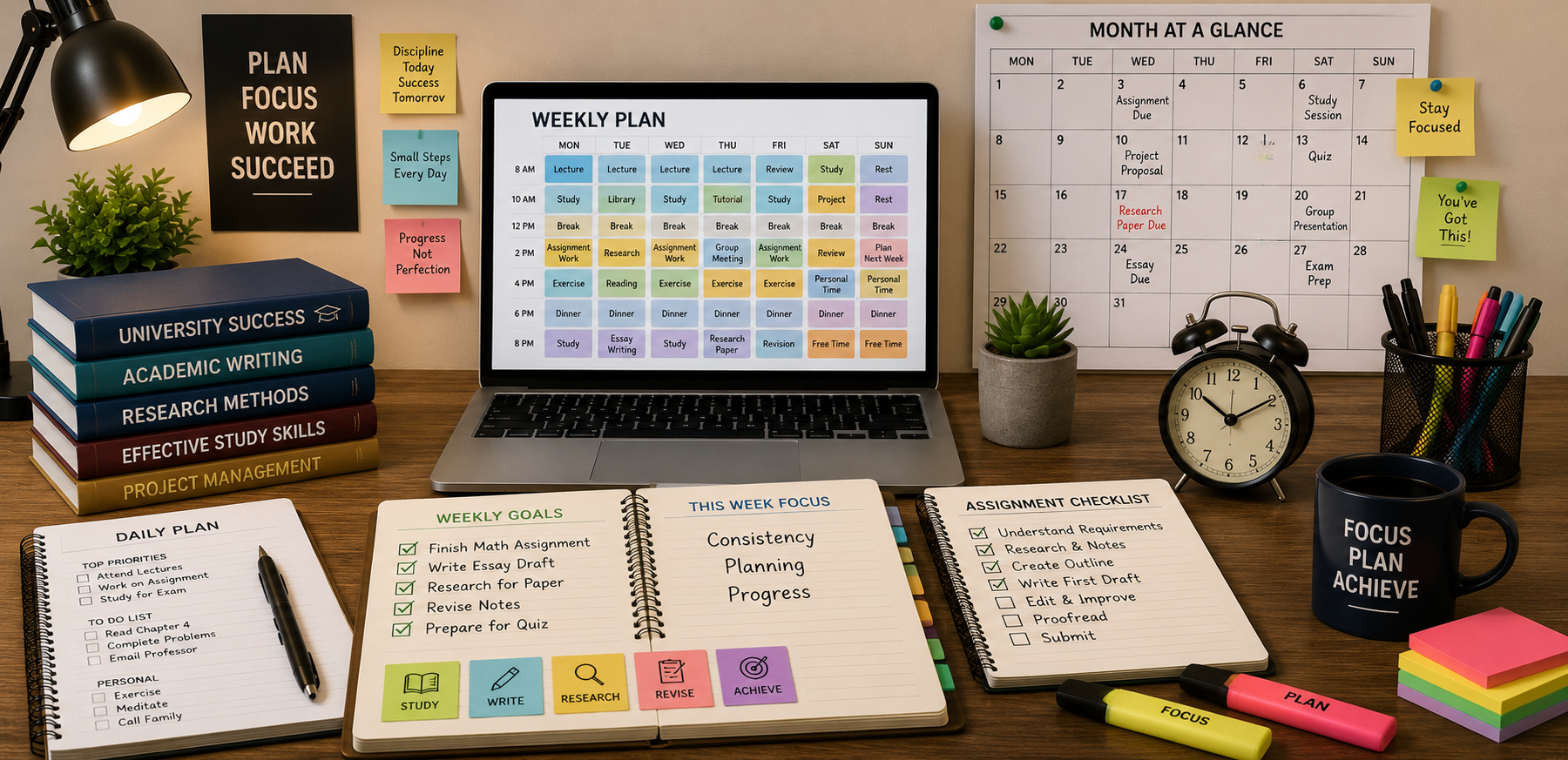
University life creates a difficult scheduling problem. Lectures, exams, social activities, personal responsibilities, and multiple deadlines compete for the same limited hours. Effective Time Management for University Students is therefore less about filling every minute with work and more about deciding what deserves attention and when.
A practical system can help students stay organized without creating an unrealistic schedule. It can also make demanding academic tasks such as Essay Writing, Assignment Writing, and research projects easier to manage. Here is a simple system you can adapt to your semester.
Why Time Management for University Students Matters
University students often have more control over their schedules than they did at school. That freedom can be useful, but it also requires greater personal responsibility.
Poor planning can result in forgotten deadlines, rushed assignments, inconsistent study sessions, and stressful exam preparation. Good Time Management for University Students creates structure before these problems appear.
The goal should not be to remain busy throughout the day. A better objective is to complete important work at appropriate times while protecting enough space for sleep, exercise, meals, relationships, and relaxation.
Step 1: Create a Semester Overview
Start with the big picture. At the beginning of the semester, collect important dates from your course outlines and place them in one calendar.
Include:
- Assignment deadlines
- Exams and quizzes
- Presentations
- Research projects
- University events
- Important personal commitments
Seeing the entire semester makes busy periods easier to identify. If three assignments are due during the same week, for example, you can begin them earlier instead of discovering the workload a few days before the deadlines.
A semester overview forms the foundation of effective Time Management for University Students.
Step 2: Plan One Week at a Time
A semester calendar tells you what is coming, but weekly planning tells you what to do now.
At the beginning of each week, review upcoming deadlines and identify your most important academic tasks. Then schedule realistic periods for completing them.
Avoid creating an enormous daily task list. Instead, identify three or four meaningful priorities. A task such as “work on assignment” is too vague. “Draft the introduction and first two sections” provides a clearer target.
Weekly planning is especially useful for Assignment Writing because it turns one large deadline into several smaller, manageable actions.
Step 3: Use Time Blocking
Time blocking means assigning specific periods to particular activities. Instead of hoping you will find time to study, you deliberately reserve it.
For example:
9:00–10:00: Lecture
10:30–11:30: Review lecture notes
1:00–2:30: Assignment research
3:00–4:00: Exercise
7:00–8:00: Exam practice
This approach gives your day structure while showing how much time is actually available.
However, effective Time Management for University Students requires flexibility. Do not schedule every minute. Leave some open space for delays, unexpected tasks, travel, and breaks.
Step 4: Prioritize by Importance and Deadline
Not every task deserves equal attention. A major project worth 40% of your grade should generally receive more planning than a short exercise worth 5%.
When deciding what to work on, consider two questions:
- How important is this task?
- How soon is it due?
Tasks that are both important and urgent usually come first. Important tasks with distant deadlines should be scheduled early enough that they never become emergencies.
This method prevents students from spending hours completing easy, low-value tasks while avoiding difficult work that has greater academic consequences.
Step 5: Break Large Projects Into Smaller Tasks
Large assignments often cause procrastination because the starting point is unclear. Breaking them into smaller actions makes progress easier.
For Essay Writing, your process might include choosing a topic, researching sources, creating an outline, writing a first draft, revising arguments, and proofreading.
The same principle applies to Research Paper Writing. Rather than treating a research paper as one enormous task, divide it into topic selection, preliminary research, source evaluation, thesis development, outlining, drafting, citation checking, revision, and final editing.
This is one of the most practical applications of Time Management for University Students because every work session receives a specific objective.
Step 6: Match Difficult Tasks With Your Best Hours
Students differ in when they concentrate most effectively. Some think clearly early in the morning, while others perform better in the afternoon or evening.
Identify your strongest concentration period and protect it for demanding tasks.
Complex reading, exam preparation, Essay Writing, and analytical work generally require more mental energy than organizing files or checking course announcements. Place difficult work during your high-energy hours and simpler administrative tasks during lower-energy periods.
Managing energy as well as hours makes a schedule more realistic.
Step 7: Reduce Distractions During Study Blocks
A 60-minute study session loses much of its value if you repeatedly switch between coursework, messages, videos, and social media.
Before beginning a focused session, close unnecessary browser tabs, silence nonessential notifications, and place your phone away from your immediate workspace when possible.
Give each session a measurable goal. Instead of saying, “I will study chemistry,” decide to “review Chapter 5 and complete 15 practice questions.”
Strong Time Management for University Students depends on protecting the time you have already scheduled.
Step 8: Build Buffer Time Into Your Schedule
One common scheduling mistake is assuming every task will take exactly as long as expected. Research may take longer, software can fail, group members may respond late, and personal responsibilities can appear unexpectedly.
Create buffer periods before major deadlines. If an assignment is due Friday, aim to complete the main draft by Wednesday or Thursday.
This approach reduces the likelihood that a small delay will turn into a missed deadline.
Step 9: Review Your System Every Week
No schedule works perfectly forever. University workloads change throughout the semester, so your system should change with them.
At the end of each week, ask:
- What did I complete?
- What took longer than expected?
- What did I postpone?
- Which study periods were most productive?
- What needs to change next week?
This short review makes Time Management for University Students an adaptive system rather than a rigid timetable.
Avoid the Trap of Over-Scheduling
Productivity does not mean studying continuously. An overloaded calendar can create stress and make the entire system difficult to maintain.
Schedule breaks and allow time for meals, exercise, social activities, and adequate sleep. A sustainable routine is more valuable than an ambitious schedule that lasts only a few days.
Remember that the purpose of planning is to create control over your workload, not to make every free hour productive.
Final Thoughts
Effective Time Management for University Students starts with a semester overview and becomes practical through weekly planning, time blocking, prioritization, focused study sessions, and regular reviews.
The most useful system is not necessarily the most complicated one. It is the system you can consistently follow. By breaking Assignment Writing, Essay Writing, exam preparation, and Research Paper Writing into manageable steps, students can reduce last-minute pressure while making steady academic progress.
Plan enough to know what comes next, but leave enough flexibility to handle real university life.